Call for Paper
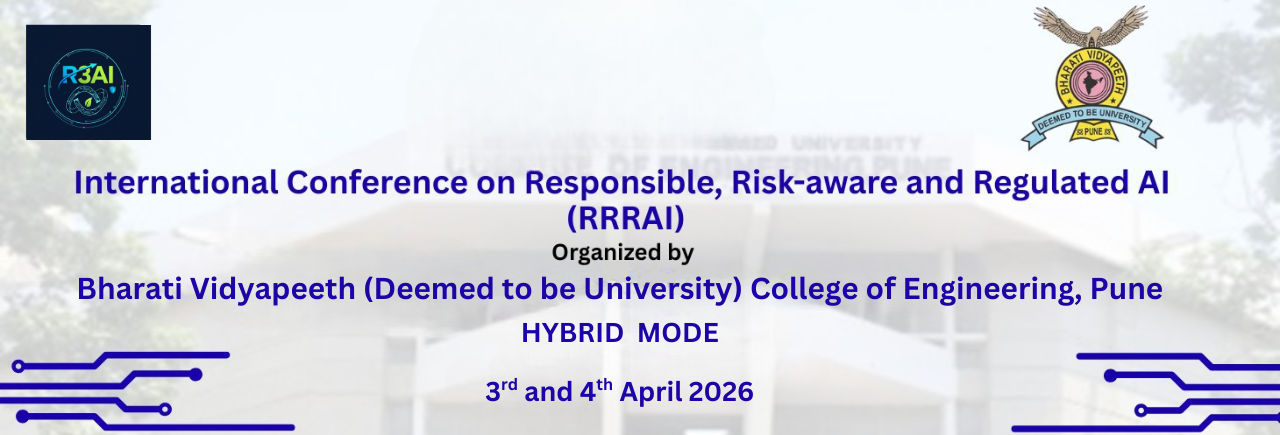
International Conference on Responsible, Risk-aware, and Regulated AI (RRRAI-2026)
The International Conference on Responsible, Risk-aware, and Regulated AI (RRRAI-2026) is envisioned as a premier interdisciplinary platform that brings together global leaders from academia, research, industry, and policy to deliberate on the transformative potential of trustworthy Artificial Intelligence. The conference highlights the urgent need for AI systems that are not only intelligent but also responsible, risk-conscious, and governed by effective regulatory frameworks to ensure fairness, transparency, and accountability in an increasingly AI-driven world.
As AI technologies continue to reshape industries, economies, and societies, it becomes imperative to address challenges such as bias detection, explainability, robustness, uncertainty quantification, safety, and compliance with global governance standards. RRRAI-2026 aims to provide a vibrant forum for knowledge exchange, critical dialogue, and collaborative innovation, encouraging contributions that span theoretical advances, applied research, industry practices, and visionary policy frameworks.
By fostering dialogue among technologists, entrepreneurs, social scientists, legal experts, and policymakers, RRRAI-2026 aspires to shape a future where AI innovation is balanced with accountability, regulation, and societal well-being. We invite researchers, practitioners, innovators, and students to submit their original research papers, surveys, case studies, industrial applications, and in-progress work for presentation and publication. Submissions should demonstrate rigor, innovation, and real-world relevance, contributing meaningfully to the global discourse on Responsible, Risk-aware, and Regulated AI.
Papers must be 8–10 pages in length and prepared in accordance with the official Springer Guidelines (link available on the conference website). Accepted and presented papers will be published in reputed proceedings to ensure wide dissemination and scholarly impact.
List of Tracks
Responsible AI
- Ethical frameworks and guidelines for AI
- Explainable AI (XAI) and transparency in decision-making
- Fairness, bias detection, and mitigation in AI models
- Human-centered AI and societal impact
- AI for social good and sustainability
Risk-aware AI
- Robustness, safety, and reliability of AI systems
- AI in high-stakes domains (healthcare, finance, defense)
- Uncertainty quantification in AI models
- Adversarial attacks and defense mechanisms
- Risk modeling and simulation in AI deployment
Regulated AI
- Policy, governance, and compliance frameworks for AI
- Legal and regulatory aspects of AI adoption
- International standards and AI governance models
- Data privacy, security, and intellectual property in AI
- Cross-border collaboration on AI regulations
Emerging Cross-Cutting Areas
- AI in climate resilience and disaster management
- AI and human rights
- AI in education and workforce development
- Industry-specific regulatory practices (automotive, healthcare, fintech)
- Balancing innovation with regulation in AI ecosystems
Multidisciplinary Engineering and Applied Sciences (Non-AI Track)
- Civil & Environmental Engineering
- Mechanical & Design Engineering
- Manufacturing & Industrial Engineering
- Chemical & Process Engineering
- Materials Science & Nanotechnology
- Energy & Sustainability Studies
- Robotics & Automation Engineering
- Electronics & Communication Engineering
Last but not the least:
- Responsible and Regulated Generative AI (GenAI)
- AI in Law Enforcement, Surveillance, and Ethics of Control
- Human–AI Collaboration: Responsibility and Liability in Decision-Making
- Building Global Consensus for Trustworthy and Risk-Aware AI
Review Process
● All submitted papers will be reviewed by at least 2 independent reviewers. Additional reviewers will be consulted if required..
● All papers will undergo a plagiarism check, and the similarity index must not exceed 10%.
● The AI detection report must show 0% AI-generated content, and all images must be original or editable (no AI-generated tools allowed).
● All papers must be formatted according to the Springer template.
● Paper acceptance will be based on originality, significance, technical soundness, and clarity of presentation.
● Authors must make sure that they submit previously unpublished papers to this conference.
Participation & Awards
● The All accepted papers that are presented will be awarded a presentation certificate..
●The Best Paper Certificate will be awarded to the author(s) of the paper selected as the best submission, based on
reviewer’s evaluations and the recommendations of the session chair.